
Solution
Surface Pool Cleaning Robot Control System
Autonomous surface skimming with coverage planning, edge cleaning, obstacle avoidance, debris collection, and coordinated propulsion control.
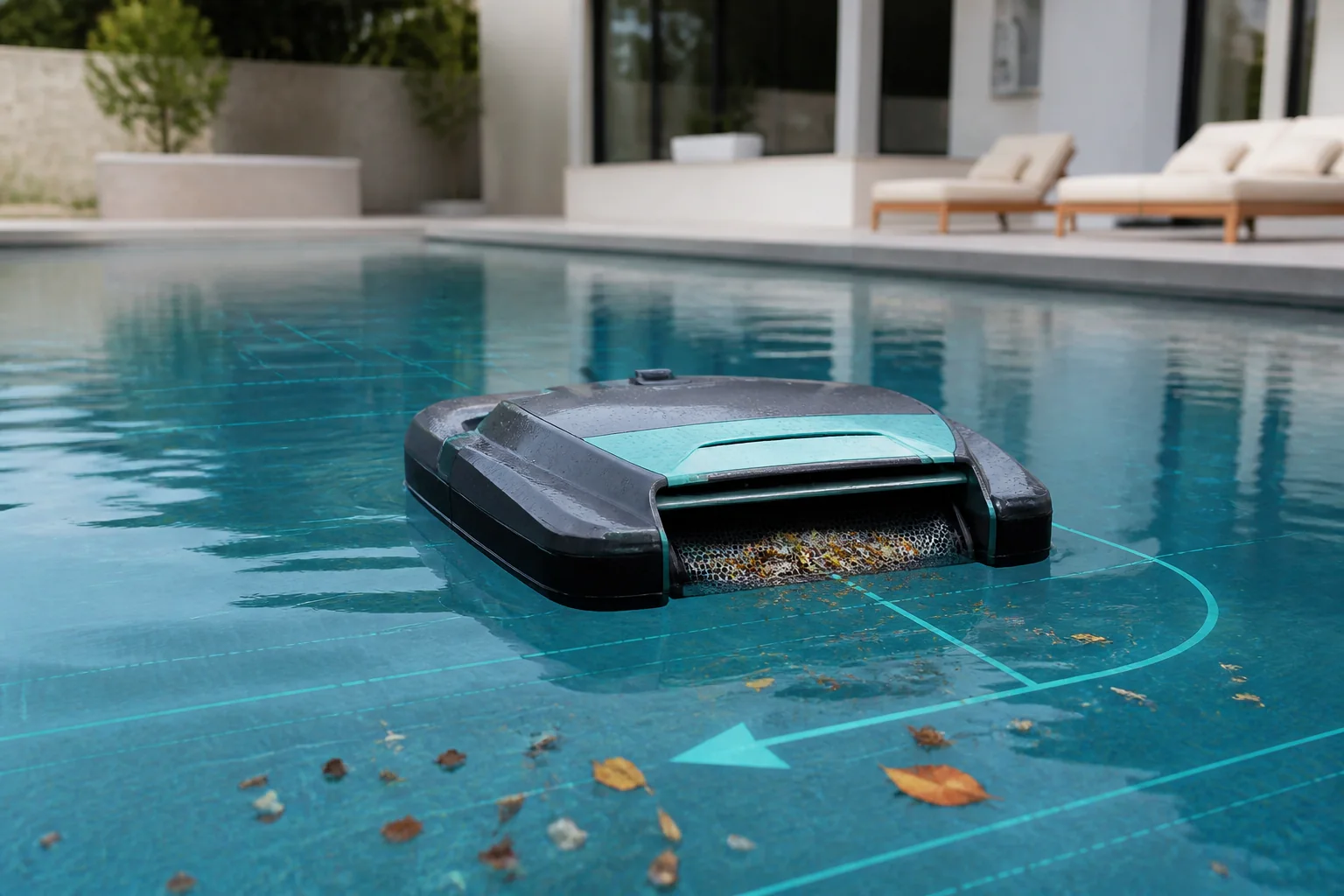
The QianEasy Surface Pool Cleaning Robot Control System is designed for autonomous floating skimmers that collect leaves, insects, pollen, dust, and other debris before it sinks. It coordinates environmental perception, route planning, differential propulsion, intake control, energy management, and safety monitoring to turn a compact surface cleaner into a dependable autonomous mobile robot.

What the control system enables
- Floating-debris collection — coordinate forward speed, intake flow, and collection-bin status for leaves, insects, pollen, and lightweight debris
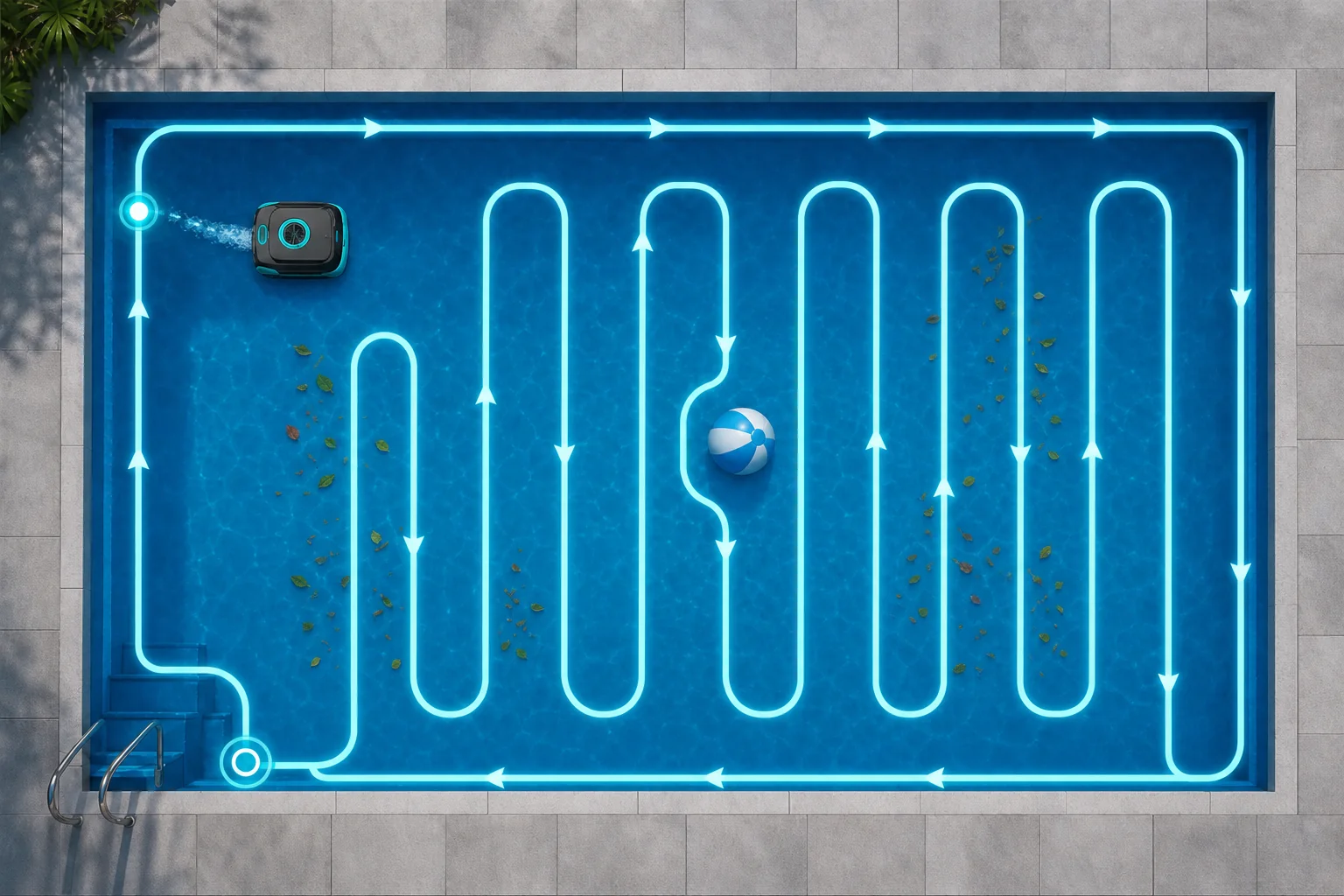
- Systematic surface coverage — plan parallel lanes and adaptive turns instead of relying on random wandering
- Edge and corner cleaning — follow pool boundaries while maintaining a controllable clearance from walls, steps, ladders, and inlets
- Autonomous obstacle avoidance — detect swimmers, toys, floating objects, and temporary obstructions, then slow, stop, or replan
- Stable motion on changing water — compensate for ripples, wind drift, asymmetric loading, and propulsion differences
- Task and energy management — estimate remaining work and battery state, support return-to-edge behavior, and expose optional charging/docking interfaces
Navigation and cleaning workflow
The robot builds a lightweight working representation of the pool from boundary observations, inertial motion, propulsion feedback, and configurable ranging or vision sensors. A coverage planner divides the surface into cleaning lanes, while the local planner continuously adjusts heading and speed around floating obstacles. Boundary events and traversed paths help identify missed areas for revisit.
Product functions
| Surface perception | Configurable camera, TOF/ranging, bumper, IMU, and motor-current inputs for boundaries, obstacles, and motion state |
|---|---|
| Coverage planning | Parallel lanes, edge following, adaptive turns, interrupted-area revisit, and configurable cleaning zones |
| Obstacle avoidance | Slowdown, stop, detour, and local replanning around swimmers, toys, ladders, and floating objects |
| Propulsion control | Closed-loop left/right thruster or paddle control with heading correction and wind-drift compensation |
| Cleaning control | Travel-speed and intake coordination, blockage monitoring, and optional debris-bin status input |
| Energy management | Battery-aware mission scheduling, low-energy response, return-to-edge, and optional docking support |
| Connectivity | BLE/Wi-Fi status, start/pause, mode selection, diagnostics, and optional OTA integration |
| Safety | Lift-out, stall, overcurrent, sensor-timeout, communications-loss, and fail-safe stop handling |
Typical mission flow
- Launch and self-check — verify sensors, propulsion, intake, battery, and communications.
- Boundary acquisition — identify the pool outline and establish an initial motion reference.
- Planned surface cleaning — execute organized lanes while collecting floating debris.
- Edge and obstacle handling — clean along boundaries and replan around temporary obstructions.
- Completion and retrieval — revisit missed areas and finish at a configurable edge or optional dock.
The final control package is tailored to the hull, propulsion form, intake mechanism, sensor set, battery capacity, pool geometry, and target product cost. QianEasy can support sensor selection, navigation algorithms, embedded control, App/communications integration, prototype tuning, and product validation.
Discuss a surface-cleaning robot control package via Contact.