
Product
Line Laser Scanning Sensor
Single-line laser scanning sensor with wide angular coverage — built for near-field robot obstacle avoidance.
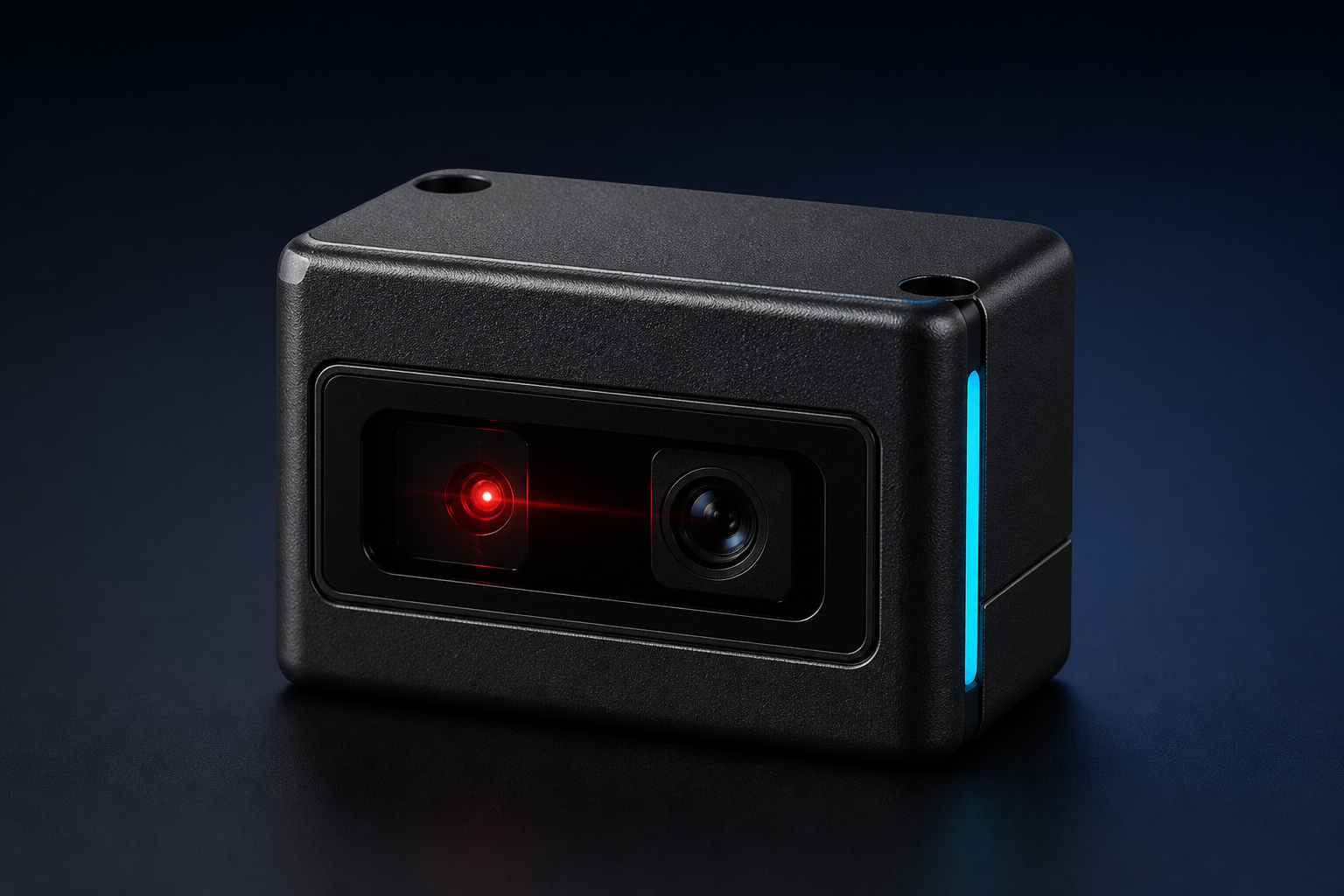
QianEasy Line Laser is a single-line laser scanning sensor: it projects an invisible near-infrared line and measures range along a wide angular sector. Unlike multi-line or solid-state LiDAR meant for mapping, it is optimized for front-mounted obstacle detection on mobile robots — vacuum cleaners, indoor service platforms, and other specialized bases that need fast, reliable near-field geometry.
What it is
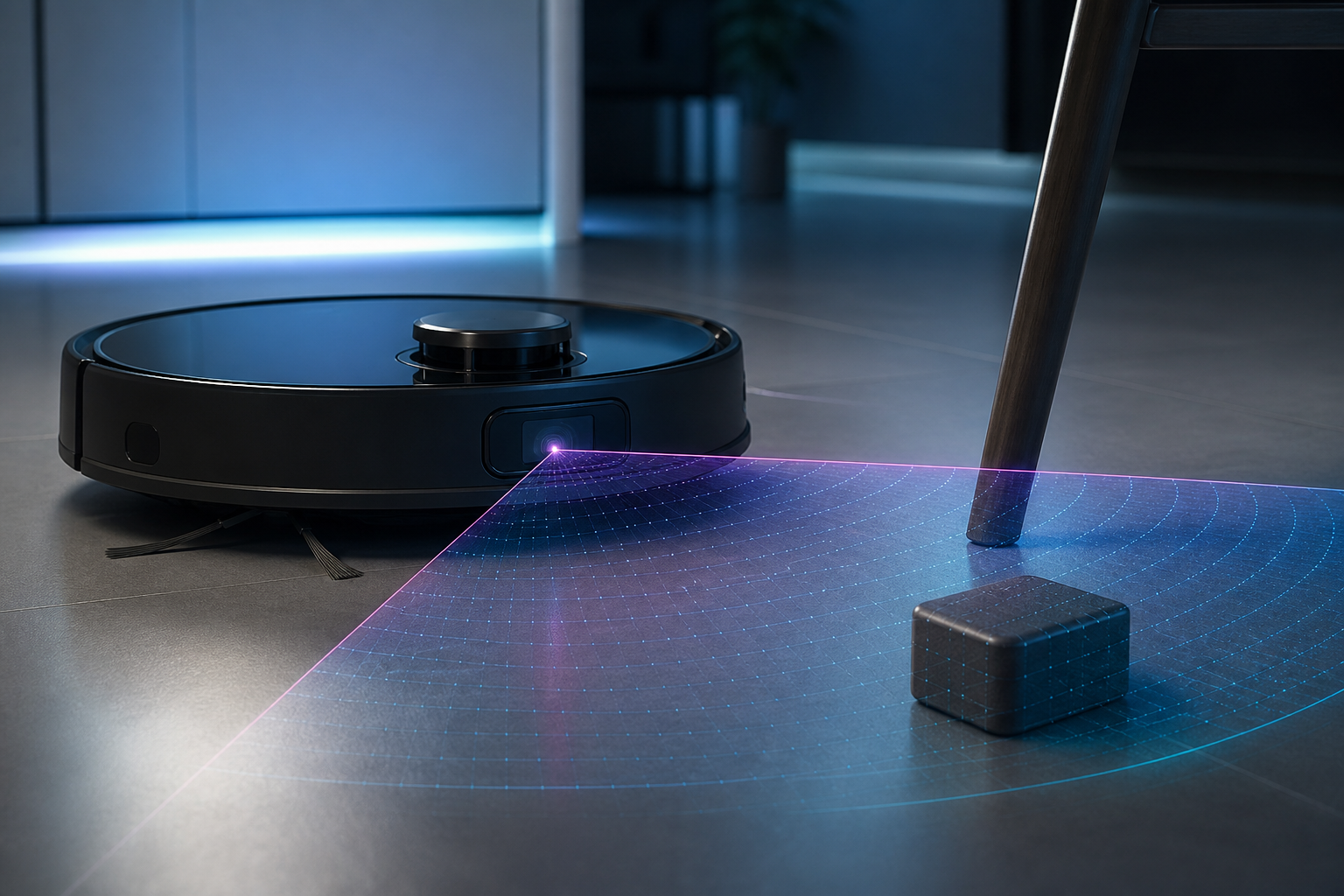
A structured-light / triangulation line scanner: the laser stripe crosses the scene; the onboard imaging path recovers distance and azimuth of obstacles within the fan. Typical install is at the robot nose, with a slight downward pitch so the line sweeps the floor plane ahead of the chassis — catching furniture legs, thresholds, and low clutter before collision.
What it solves
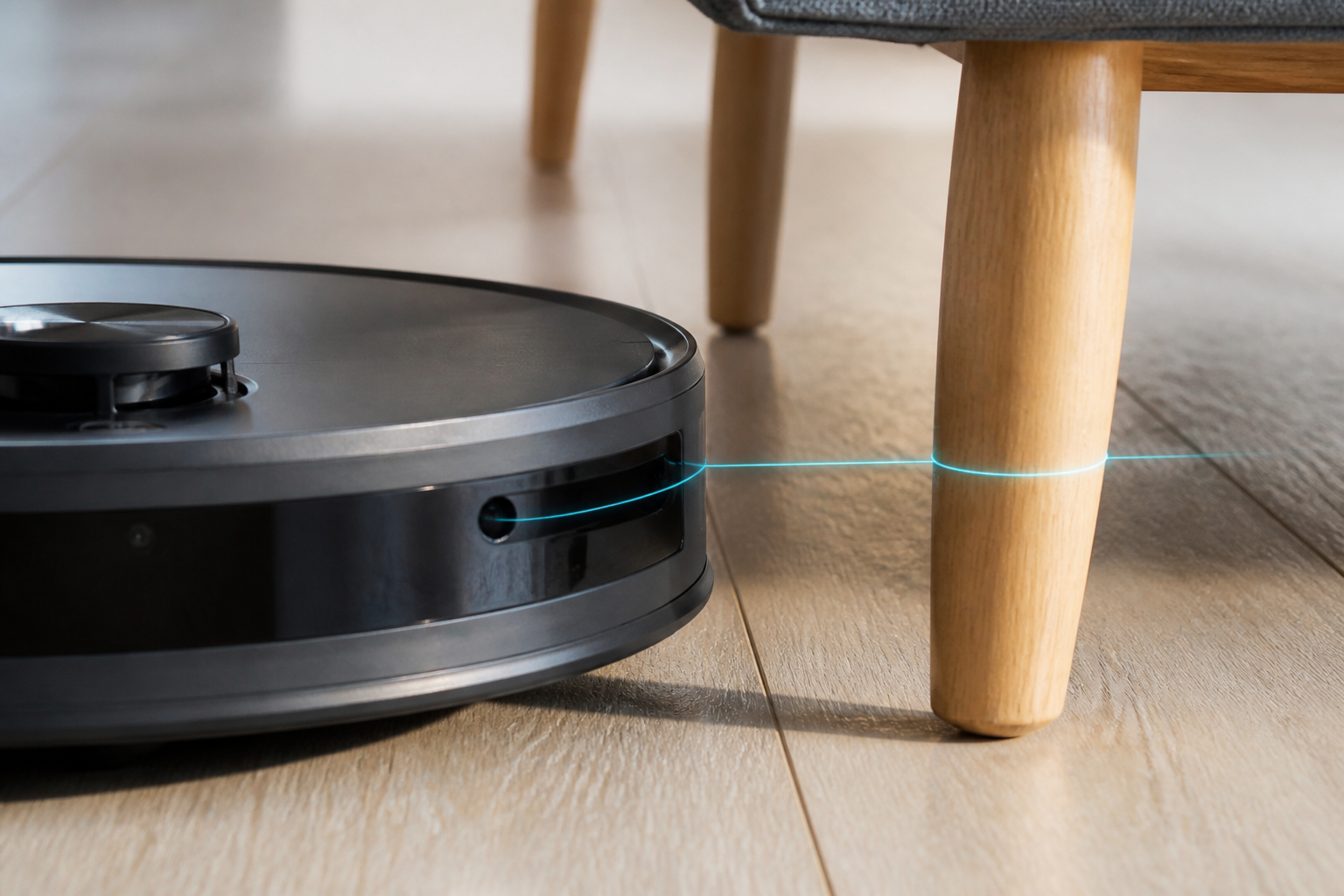
Wheel LiDAR and navigation cameras cover mid-range space, but bumpers still need a dedicated near-field layer. Line laser fills that gap with high update rate and wide FOV, so the control stack can slow, steer, or reverse before contact — especially in cluttered homes and corridors where centimeter-class front geometry matters.
Key capabilities
- Single-line angular scan — wide fan (typ. 120°) for front obstacle coverage
- Near-field ranging — short working distance suited to bumper / chassis clearance
- Ambient-light resilience — designed for bright indoor scenes (up to ~50k Lux class)
- Robot-friendly I/O — I2C / UART class interfaces into MCU or perception boards
- Eye-safe NIR — Class 1 laser safety (IEC 60825-1) on reference packages
Typical specifications (reference module)
Values below describe a typical obstacle-avoidance package; wavelength, range band, and housing can be tuned per project.
| Sensing type | Single-line laser scanning / structured-light ranging |
|---|---|
| Laser source | NIR line laser (typ. 808–850 nm) |
| FOV | 120° |
| Pitch (install) | ≈15° ±2° downward (application dependent) |
| Ranging range | Typ. 30–300 mm (white target); short-band packages ≈20–120 mm |
| Frame / sample rate | Typ. ≥20 Hz / ≈20 fps |
| Angular resolution | Typ. ≈0.75° (package dependent; <1.2° class) |
| Ambient light | Up to ≈50,000 Lux |
| Data interface | I2C / UART |
| Supply | 5 V |
| Operating temp. | −10°C ~ +45°C (humidity per package) |
| Storage temp. | −30°C ~ +70°C |
| Module size | Typ. 28 × 21.3 × 10.8 mm |
| Laser safety | Class 1 (IEC 60825-1:2014, 3rd ed.) on reference SKUs |
| Module life | Typ. ≥3,000–10,000 h (package dependent) |
Mounting guidance (vacuum / mobile robot)
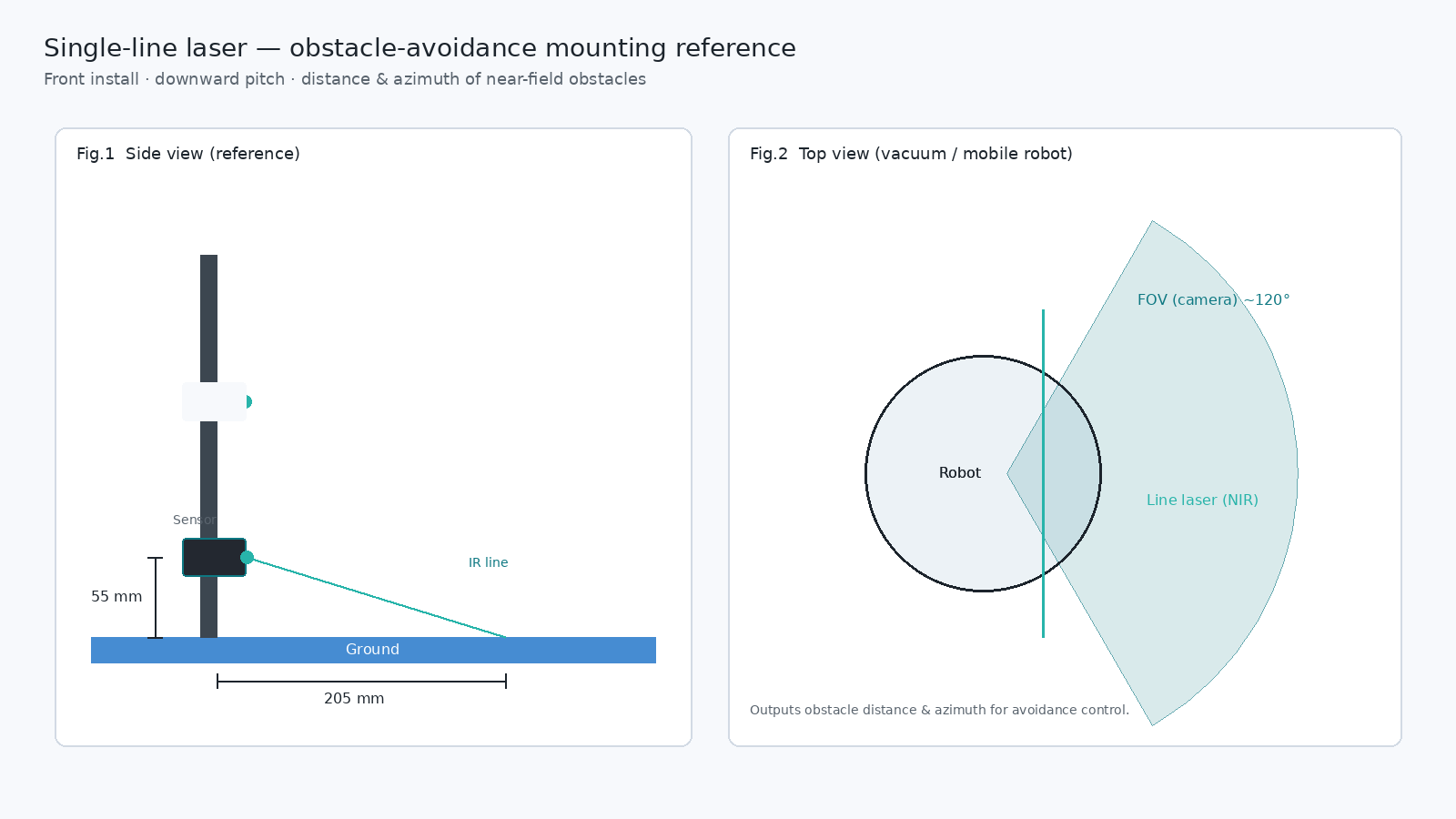
- Install at the front of the chassis; laser line roughly horizontal toward the ground plane ahead.
- Reference geometry: mount height ≈55 mm, ground intersection ≈205 mm forward (tune with pitch and robot clearance).
- Align so the camera FOV covers the projected IR line; the controller then estimates obstacle distance and azimuth for avoidance.
Where it fits in QianEasy stacks
In robot vacuums and other indoor mobiles, line laser is the near-field bumper sensor. In wheelchair, golf-follow, and pool platforms it complements TOF / array LiDAR: LiDAR for mid-range space, line laser for immediate front geometry that must not be missed.
Talk to engineering via Contact.